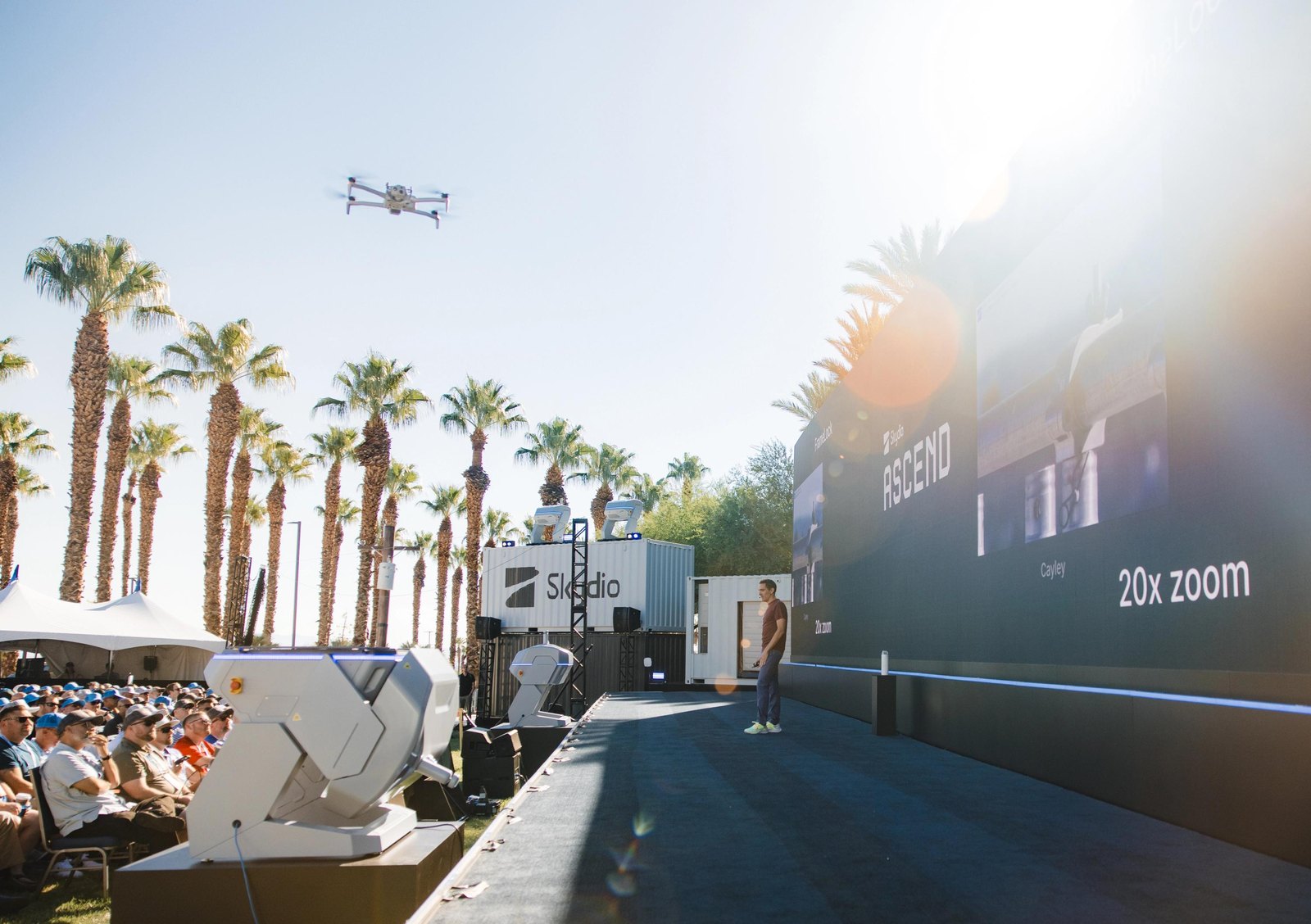
At its September 2026 Ascend event in Summerlin, Nevada, Skydio introduced an aircraft-and-dock combination that changes the ground operation as much as the flight. F10 Lightrunner is a fixed-wing drone; MegaDock uses a robotic arm with a suction gripper to launch and recover it. Skydio says customer deployment is planned for 2027. This is an announced system, not evidence of a mature operational fleet. Skydio’s Ascend announcement
The robotic arm changes the ground operation
The important idea is the removal of a recurring handoff. If a ground crew must prepare, launch and recover every aircraft, autonomous flight leaves a labor-intensive step at each end of the mission. A dock that handles those steps can make repeated remote dispatch more practical. That is the promise to test: completed missions per staffed hour, including failed recoveries and maintenance, rather than flight autonomy in isolation.
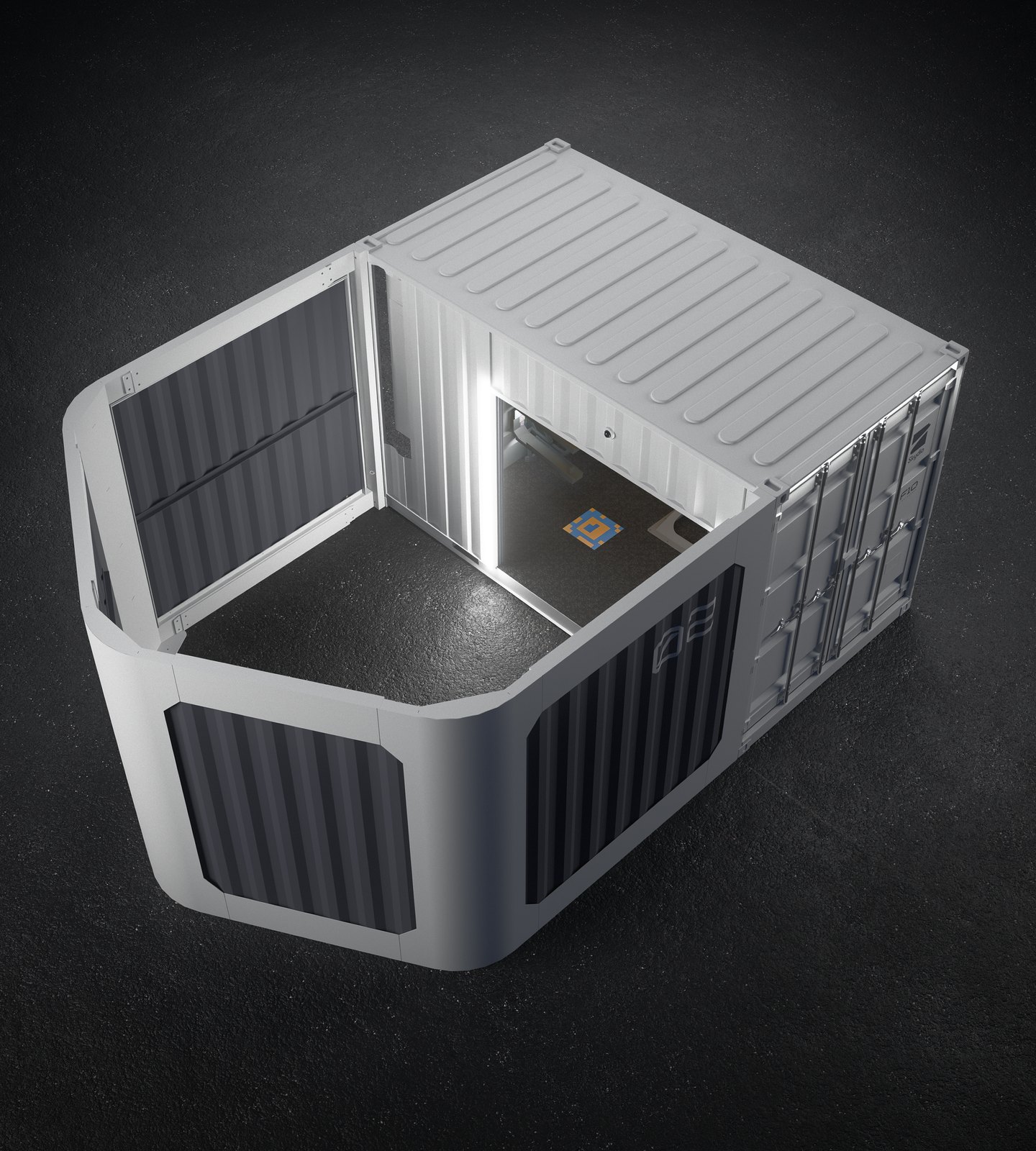
Skydio describes MegaDock as housing up to five F10 aircraft. Storage capacity does not establish how many simultaneous emergencies an agency can manage. The arm may automate aircraft handling while incident judgment, airspace decisions and dispatch coordination remain with people. The hardware announcement and the Security Command software announcement therefore belong in the same story: one reduces work at the launch site; the other tries to organize work across sites.
Skydio’s September 24 platform announcement contained a detail that matters more to a security director than another flight-speed record: Security Command is intended to let one operator oversee drones across multiple sites. The company said the software could be purchased immediately, with general availability in early 2027. That is an announced product timetable, not evidence that every promised workflow is already deployed. Skydio’s September 24 platform announcement
The underlying idea had a visible precursor. On March 20, Skydio demonstrated one operator managing four drones in California and Colorado. The company’s recording showed alarm-driven response within a shared interface. The useful question is no longer whether one person can see four feeds. It is whether that person can handle the moments when several feeds demand judgment at once. Four-drone demonstration, March 20, 2026
Routine flight is not the same as incident work
A conventional patrol assigns people partly because movement and observation consume time. A remotely piloted aircraft changes the movement; autonomous navigation changes how much continuous steering the flight requires. Multi-site operation attempts a further change: pooling the attention of a smaller team across geographically separate properties. That is where the largest economic promise—and the hardest operating question—sits.
Several aircraft can follow routine routes while one person intervenes occasionally. Several ambiguous incidents are different. One site may show a person near a restricted gate while another loses connectivity and a third needs a decision about following a vehicle. The operator is not merely dividing screen space. They are prioritizing events whose significance and urgency differ. A calm demonstration establishes a capability, but cannot establish the staffing ratio for that busier scenario.
This distinction prevents a misleading equivalence. A drone-hour is not automatically a guard-hour. An aircraft may inspect a roof or perimeter faster, but it cannot perform every task assigned to a person on the ground. Conversely, a guard walking a route may provide little additional information during uneventful periods. The correct comparison separates the tasks before combining the costs.
From an aircraft console to a security workflow
Skydio’s physical-security FAQ says its video can appear in Genetec Security Center and Milestone XProtect as live camera feeds. That matters because a security team already uses those systems to organize observations and responses. Integration can reduce the friction of adding an aerial viewpoint; it can also leave important responsibilities split between the flight interface and the incident-management environment. Skydio physical-security FAQ
The practical difference is whether a drone is another screen or a resource attached to an incident. If the alarm, flight, observations and disposition remain connected, another operator can understand what happened without reconstructing it across applications. If they do not, the flight may be autonomous while the administrative work remains manual. The labor calculation must include both.
Security Command’s announcement described scheduling, response and automatic logging as part of the proposed workflow. It also put the product alongside Asset Command for inspection. That division is strategically revealing: the same flight technology is being packaged around different customers’ units of work. Security buys incident handling and coverage; maintenance teams buy asset observations. A common aircraft does not make their operating requirements interchangeable.
Attention is the scarce resource
Our central finding is a shift in the bottleneck. Once routine flight requires less attention, the limiting resource becomes the time needed to resolve exceptions. That does not make multi-drone operations impractical. It means the valuable capacity measure is the number and complexity of simultaneous interventions a team can absorb without delaying an important response.
An illustrative model makes the distinction clear. Suppose several sites usually require brief checks, but bad weather generates clusters of alarms across the region. Average weekly workload might look comfortably low while the busiest ten minutes overwhelm the shared operator. Adding aircraft does not fix that bottleneck. Better alarm filtering, another qualified operator or a narrower operating scope might. The appropriate answer depends on the cause of the workload.
Geographic diversity can help if demand peaks occur independently. It helps less when sites share weather, network providers or coordinated operating schedules. The economic advantage of a centralized team therefore depends partly on relationships between sites, not just the number of sites. That is an important question for security-service providers assembling national portfolios.
What the demonstration proves—and what it leaves open
Skydio’s March recording is useful evidence that coordinated remote operation can be shown in public. Its accompanying materials describe a sequence from intrusion alert to launch, live view and operator response. They are supplier-run demonstrations, not an independently audited comparison of loss rates or total security costs. The distinction is especially important when a presentation translates routine coverage into an equivalent number of guards.
The company’s software datasheet explicitly describes one-to-four operations. Separately, FAA guidance identifies multiple-aircraft operation as a category for which a Part 107 waiver may be required. An advertised software ratio is thus neither a universal permission nor an unconditional staffing recommendation. Each operating arrangement must fit its authorization and actual workload. Skydio Dock DFR software datasheet FAA operational-waiver instructions
There is also a basic product-timing boundary. The September announcement combines existing aircraft capabilities, new interfaces and future deliveries. F10 Lightrunner and MegaDock, for example, were described as deploying to customers in 2027. They should not be used as evidence of capacity already available in the March demonstration or in an existing customer’s fleet.
The counterargument: centralization creates its own fragility
Pooling expertise can improve consistency, but it can also concentrate failures. An unavailable operations center, shared login problem or communications outage may affect several sites at once. Local staff still need an intelligible fallback. A central console is valuable only if people on the ground know what it has and has not confirmed.
The other limit is context. A local guard may recognize a regular contractor, a changed delivery arrangement or a damaged gate immediately. A remote operator needs that context supplied reliably. Standardized workflows can help, but standardization that strips away relevant local information may increase unnecessary escalations. Automation does not remove the value of knowing the property.
Watch the busy interval
As Security Command approaches general availability, the most useful results would show intervention time, unresolved alarms, operator handoffs and response delay at peak demand—not only missions flown. They should also identify work transferred to local staff and maintenance teams. A favorable result would demonstrate that shared supervision remains effective when activity stops being routine.
That is the consequential bet behind Skydio’s platform. Its potential advantage is not four aircraft on one screen. It is the ability to pool human attention without losing effective response. If the company and its customers can demonstrate that under pressure, autonomy will change the economics of multi-site security. If they cannot, the attractive ratio will remain a demonstration statistic.
References
Questions, news tips or corrections? Contact [email protected].