A response robot becomes useful when it can carry the right equipment to a difficult place while its operator retains enough information to make a sound decision. Mobility alone is insufficient if a video link fails, a payload cannot be delivered or the platform cannot travel with the team.
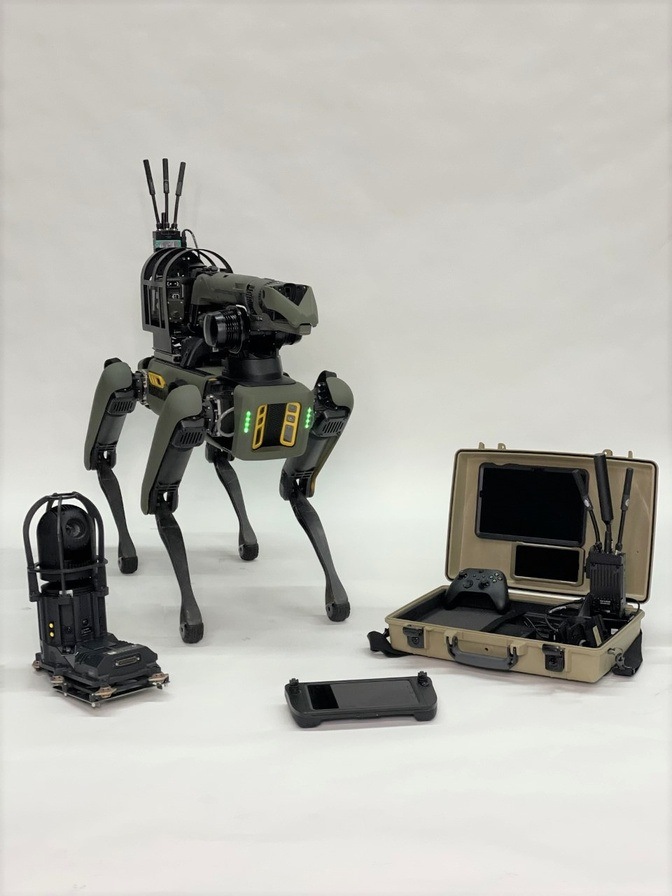
A DHS Science and Technology account republished by Homeland Security Today on November 2 describes El Paso assessments of RADēCO’s Cerberus and mobile networking equipment. Cerberus, built on Boston Dynamics’ Spot, was remotely operated. In one scenario it carried an individual first-aid kit up three flights of stairs to a designated location. Other work examined environmental sensing and compatibility with transport platforms, including a UH-60 helicopter. The account describes assessment scenarios, not an autonomous rescue deployment or a measured reduction in casualties. Read the primary source account.
Integration determines the usable distance
The physical distance between a responder and a hazard is valuable only while the responder can interpret what is happening. Camera placement, sensor presentation and communications quality all affect that interpretation. An equipment list establishes what a platform carries; a field assessment can expose whether the combination supports a particular task.
The accompanying networking work evaluated body-worn systems from Persistent Systems and Silvus Technologies and explored communication with existing land mobile radios. That matters because response organizations rarely replace their entire communications environment at once. An additional network must fit the information and command practices already in use.
A completed scenario leaves operational questions
The stair-delivery example is meaningful because it connects movement to an intended payload destination. Further evaluation would need to preserve the conditions: route preparation, operator training, communications availability and assistance required. Without those details, a successful demonstration should remain a bounded result.
Agencies would also need to examine recovery. If a robot stops in a hazardous location, retrieving it can create a new task for the response team. Appropriate acceptance criteria would account for that burden alongside the tasks completed at a distance.
Test the task with the intended team
An operator who is closely involved in a demonstration may have familiarity that a receiving agency’s personnel do not yet possess. Acceptance work should therefore examine training, preparation and the division of responsibilities within the team. The platform’s usefulness depends on whether the intended users can operate it under their own procedures, rather than only whether a specialist can complete a selected route.
Payload delivery is similarly a chain of responsibilities. Reaching a designated location is different from placing equipment where a recipient can use it. An agency evaluating the approach would need to define the end of the task and record any human assistance. That preserves the value of a stair-climbing demonstration while making its relationship to an actual response clearer.
Transport compatibility creates its own boundary. Being carried by a helicopter can be an important integration step, but it does not answer how long loading takes, what equipment travels with the robot or how quickly the team can begin work after arrival. Those questions connect the vehicle demonstration to the pace of a response. The reported assessment does not provide a complete set of deployment-time measures.
The networking and robotics results should also be kept distinct unless a source identifies the combined configuration tested. Several technologies appearing in one exercise does not establish that every platform used every radio system. A precise record of configurations, failures and operator actions would make the assessment more useful to agencies deciding which combination to evaluate next.
Environmental sensing requires its own interpretation chain. A sensor reading must retain its units, location, timing and relevant operating limitations before it can support a response decision. Carrying a sensor into a difficult space does not establish the accuracy of every reading or authorize an operator to infer a safe environment from incomplete information. A task-specific assessment would connect the sensing payload to an agreed procedure for interpreting results and escalating uncertainty. That would make the robot’s contribution clearer: it can extend access to observations while trained personnel remain responsible for deciding what those observations justify.
The assessment’s immediate contribution is a more realistic view of how a commercial robot can complement responders. It does not require calling the platform autonomous to be important. The wider opportunity is to improve standoff work through dependable mobility, useful sensing and clear human control, with repeated operational evidence determining where greater automation is justified.
Source organizations: RADēCO, Boston Dynamics, U.S. Department of Homeland Security.
References
Questions, news tips or corrections? Contact [email protected].