A robot working beside a race route has to fit around people whose movements are difficult to predict. Its value depends on a narrow, understandable job and a safe way to stop or return responsibility to staff when the environment changes.
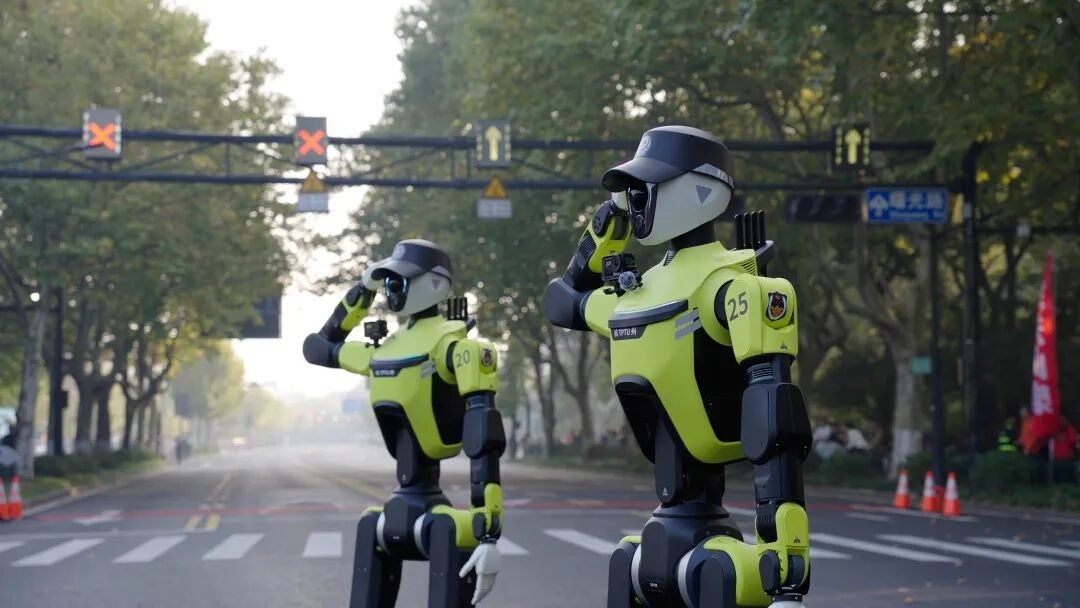
DEEP Robotics’ November 1 company account, republished by Tonghuashun, says Hangxing No. 2 supported the Hangzhou Marathon at four locations around Huanglong Sports Center. Reported duties included intersection monitoring, preset-route patrols, traffic-safety reminders and public inquiries. The company describes stopping, avoiding obstacles or ending a patrol in safe standby when a route cannot be used. These are supplier-reported behaviors; the release does not provide a measured intervention rate or independently verified reduction in staffing needs. Read the primary source account.
The operating boundary is part of the product
Preset routes make an event deployment more tractable than unrestricted movement through a city. They give staff a defined area to assess and a repeatable pattern to supervise. They also limit what a successful deployment establishes: performance on a prepared route does not establish competence in every nearby public space.
The company describes preparatory exercises and remote takeover among the scenarios it tested. An operational evaluation would benefit from publishing how often staff intervened, what caused those interventions and how quickly a safe state was reached. A robot’s ability to stop is useful only if the stop itself does not create an avoidable obstruction.
Assistance needs a clear source of authority
Standardized reminders and public information can relieve repetitive work if people understand them and staff can correct them. The harder cases involve ambiguity: a conflicting instruction, an emergency vehicle or a person asking for help outside the prepared information set. Those situations should transfer cleanly to a responsible person.
There is also a difference between recognizing a possible traffic violation and deciding how to respond. The release supports an account of assistance to traffic personnel. It does not establish autonomous enforcement authority or demonstrate that every machine-generated interpretation was correct.
Count the work transferred back to people
A patrol robot’s apparent independence can be misleading if the supporting work is omitted. Event preparation, route checks, monitoring and interventions all consume staff time. A useful service evaluation would record that effort together with the tasks the robot completes. The result could still be favorable, but it would describe the actual operating arrangement instead of treating a moving robot as evidence that supervision has disappeared.
Public interaction adds another dimension. A prepared answer can be accurate while failing to resolve a person’s situation. Teams need a clear route for questions that the system cannot answer and a way to correct instructions if the event plan changes. The source describes public-service functions; it does not publish an independent assessment of how participants understood or used them.
A crowded race setting also makes consistency valuable. Staff need to recognize the platform’s intended behavior without guessing whether a pause represents a planned stop, an obstacle response or a fault. Clear status indication and a known escalation process can make bounded automation easier to integrate. Whether the reported deployment achieved that consistently would require operational observations beyond the announcement.
The next deployment could provide stronger evidence by retaining a simple denominator: how long the robot was scheduled to work, how long it was available and how many tasks required intervention. Those measures would help distinguish a successful public demonstration from a repeatable service. They would also make comparisons across routes more meaningful without assuming that one event represents all public-space conditions.
The public setting also creates a communication requirement for the service itself. People should be able to tell whether the robot is providing prepared information, relaying an instruction from staff or waiting for assistance. Confusion about that role can undermine an otherwise technically successful interaction. A future assessment could examine whether participants recognize the source of instructions and can readily reach a responsible person. That would add a service-quality measure to mobility and availability figures. The company account establishes the intended public-facing duties, while leaving those interaction outcomes to be measured in a more detailed operational evaluation.
The event provides a concrete deployment setting for an emerging humanoid service. Its broader significance will depend on repeatable performance and evidence that the robot reduces routine workload without adding disproportionate supervision. Reporting intervention frequency, availability and public-service outcomes would make the next deployment easier to evaluate.
Source organizations: DEEP Robotics.
References
Questions, news tips or corrections? Contact [email protected].